AI Strategy
•
Tim Hillegonds
The IDEA Framework™ for AI Strategy
Most AI initiatives are execution in search of a strategy. The IDEA Framework™ gives leaders a way to pressure-test assumptions, align teams, and adapt deliberately before the cost of failing fast becomes too high.
A couple of years ago, I introduced the IDEA Framework™ for Strategy. After more than a decade of strategy work, I created it as a response to a question I kept asking during client engagements: How do you know your strategy is right?
Most leaders and teams would answer that question with a shoulder shrug, or a response that even they didn't seem to believe. A vague reference to market research. A nod to competitive analysis. That sort of thing. So I built the framework to fix that, to give organizations a rigorous, repeatable way to arrive at a high level of confidence in their chosen strategy before they committed to it.
What I didn't anticipate was how essential that process would become in the AI era.
The Problem With Adopting AI in Siloed Departments
Walk into most organizations today and you'll find individual departments—marketing, operations, finance, product—each running their own AI initiatives. They'll have their own tools, their own prompts, maybe even their own workflows. But ask those teams what the organization's AI strategy is, and you'll get as many different answers as there are departments. That's the literal definition of execution in search of a strategy.
The fail-fast philosophy hasn't helped either. Companies have turbocharged it in the AI era, reasoning that because the pace of change is so relentless, the only way to keep up is to act first and think later. But failing fast is still failing. And as Harvard Business School research suggests, most strategic plan failures—somewhere between 60 and 90 percent—aren't execution failures at all. They're assumption failures—meaning: the strategy was wrong before anyone began to implement it.
The question worth asking isn't how do we fail faster. It's how do we increase our chances of not failing at all?
A Strategy for Your Strategies
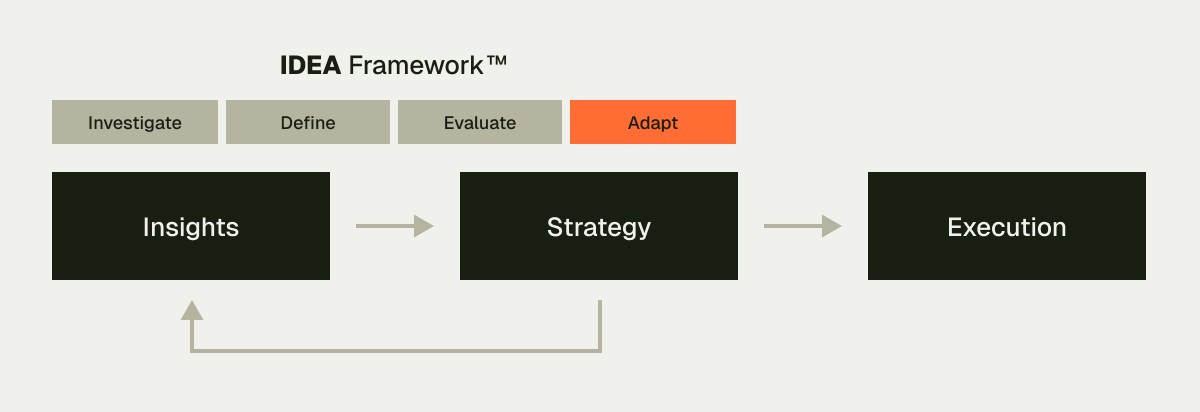
The IDEA Framework™ is a meta-strategy, meaning it’s a strategy for strategies. It guides the development process itself, ensuring that before you commit to a direction, you've done the work to know it's the right one.
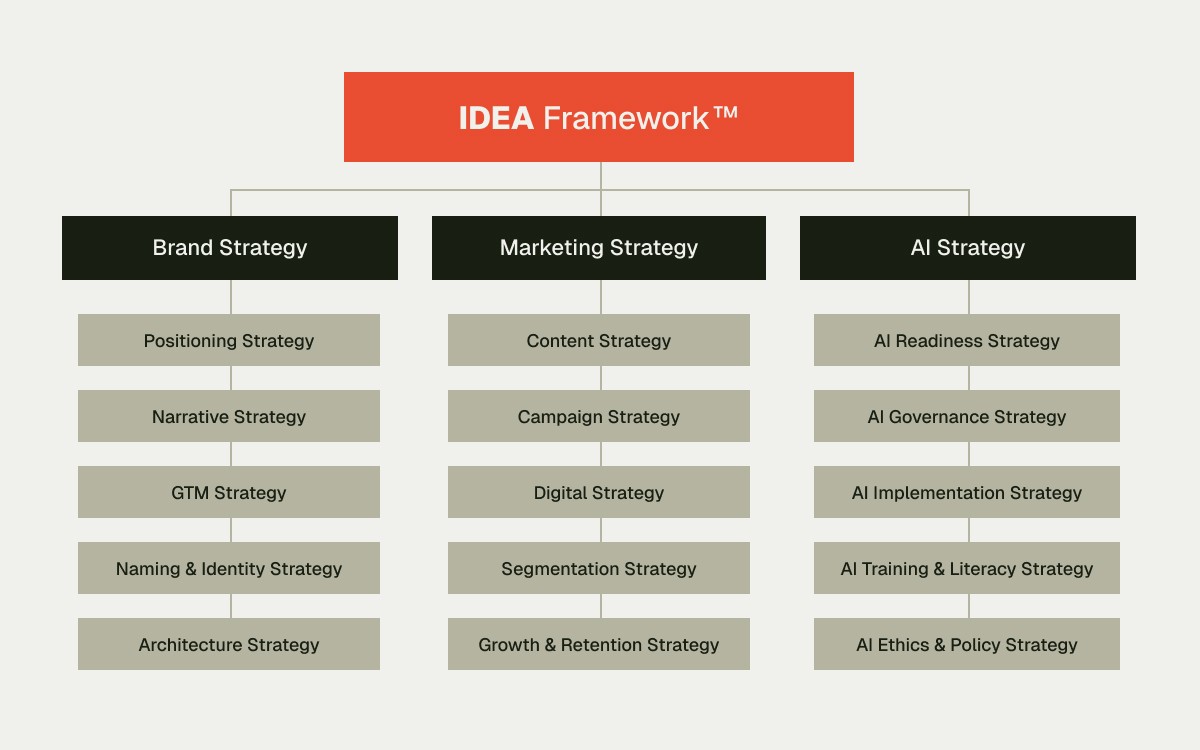
As Seth Godin writes in Strategy, "Strategy is a philosophy of becoming." What you are becoming right now is an AI-forward company. The question is whether you're becoming that deliberately, or by accident.
Here's how to apply the IDEA Framework in the AI era.
Investigate
The investigation stage is where you ask the hard questions—of your leadership team, your department heads, your employees, your customers, and your market. You surface and stress-test your assumptions: We assume our customers will trust AI-generated outputs. We believe this workflow can be automated without degrading quality. We think our team has the capacity to absorb this change. You form those hypotheses explicitly, then see whether they hold up under scrutiny.
This is also where siloed AI adoption gets exposed. When you map what each department is actually doing and ask how those initiatives connect, the gaps become visible. But you're not looking for absolute certainty, just enough clarity to Define.
Define
Once the idea has been properly investigated, it must be rigorously defined in strategy-level terms. The logic should be simple enough to articulate clearly: We learned this, so we're doing that.
For AI strategy, this means defining not just which tools you're adopting, but what organizational capability you're building, what customer problem you're solving, and what success looks like in measurable terms. If you can't define it, you can't evaluate it. If you can't evaluate it, you can't adapt it.
Evaluate
Even the most thoughtfully defined strategy must be pressure-tested before full commitment. The evaluation stage is where you stress-test your assumptions, establish clear criteria for success, identify risks, and assess whether your strategy aligns with your organization's actual capabilities. You want to move into execution with confidence rather than hope.
In the AI era, this stage is ongoing. What's technically feasible all the time. A strategy that was sound even a month or two ago may need significant adjustment today.
Adapt
Adaptation is the hallmark of every enduring idea, and often the trigger for beginning the IDEA Framework™ anew.
Organizations that treat their AI strategy as a fixed document will fall behind. The ones that treat it as a living system, constantly refined by what they're learning, are the ones that compound their advantage over time. Based on new insights, changing conditions, or what you're learning in execution, you Investigate again, Define again, Evaluate again. The process is circular because strategy requires it.
Why Fail Fast When You Can Not Fail at All?
The fail-fast philosophy has its place, but it was never meant to be applied to the strategy itself. It was meant to be applied to the experiments you run after you have a strategy worth testing.
Skipping the pressure-testing phase doesn't make you faster. It makes you more exposed. The cost of failure in the AI era—in wasted resources, in teams pulled in wrong directions, in competitive ground lost while you regroup—is too high to treat failure as a default learning mechanism.
You don't need to fail fast. You need a framework that increases your chances of not failing at all.
The IDEA Framework™ is that framework. Use it.

Related Insights