Most leadership teams approach AI maturity as a single problem they can solve through training, tools, and pilots, but the work required at each stage is fundamentally different. The companies that scale AI know the difference between a skill problem, a structure problem, and a belief problem.
When AI lands on a leadership team’s agenda, the first instinct is almost always the same: Treat it as a training problem. Pick the tools, identify the early adopters, watch productivity tick up. The instinct is reasonable, but this kind of progress has a ceiling, and most companies hit it without realizing they have. They mistake an early-stage win for a strategic one, double down on the same playbook, and wonder why the gains never compound.
To make sense of this, I’ve adapted McKinsey’s Three Horizons model, introduced by Mehrdad Baghai, Stephen Coley, and David White in The Alchemy of Growth (1999). It was originally a way to think about how companies should manage innovation across short, medium, and long timeframes: defending the core, building emerging businesses, and seeding transformative ones.
What I've done here, however, is adapt it for a different question. Not how a company sequences innovation, but how it actually matures in its use of AI.
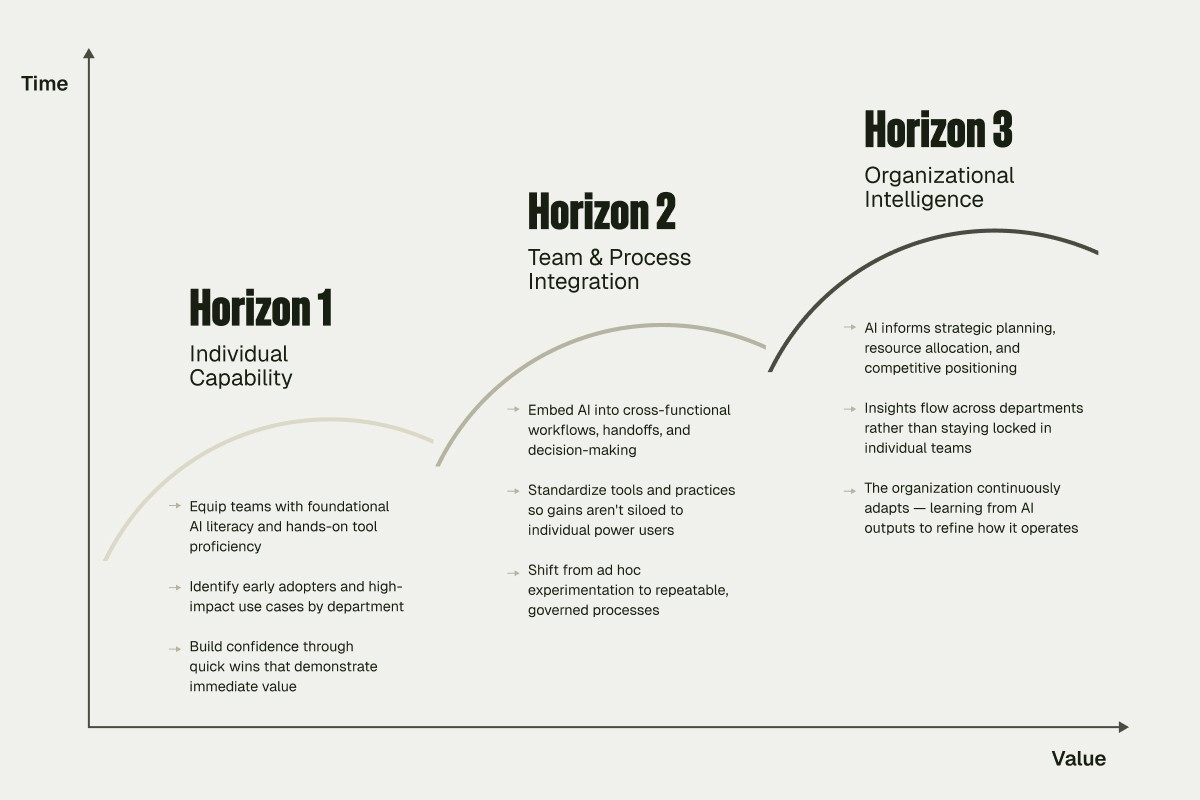
The three horizons of AI maturity are individual capability, team and process integration, and organizational intelligence. They sound like progressive degrees of the same problem, but they’re actually not. Each horizon is a fundamentally different kind of problem, and the move from one to the next requires a fundamentally different kind of work.
Horizon 1 is a skill problem.
The unit of change here is a person. You make people more capable in literacy, tool fluency, and prompt craft, and you concentrate effort on the early adopters who can demonstrate value quickly. This work is tractable because skills compound, and because individuals can change without the organization changing around them.
It is also where most companies live. McKinsey’s State of AI report from November 2025 found that 88 percent of organizations now use AI regularly in at least one business function. Only about 6 percent qualify as AI high performers, defined as companies seeing EBIT impact of 5 percent or more directly attributable to AI. Nearly two-thirds report that they have not yet begun scaling AI across the enterprise. The gap is not a failure of usage. It is a failure to graduate from Horizon 1.
Horizon 2 is a structure problem.
The unit of change here is a workflow. Embedding AI into cross-functional handoffs means redesigning those handoffs, naming the owners, deciding which decisions get made faster, and which decisions get made differently. Standardizing tools means choosing what stays and what gets retired, which is a political act, not a procurement one. Building governance means writing the rules that no one wanted to write while experimentation was still easy.
This is the hardest hand-off in the model, and it is where most “AI strategies” turn out to be Horizon 1 strategies in disguise. You can have the most prompt-fluent workforce in your industry and still be at Horizon 1 if no workflow has been rebuilt. McKinsey’s research shows that what most distinguishes AI high performers from everyone else is precisely this: they are actively redesigning workflows around AI rather than bolting it onto the workflows they already have. Skills are the input. Structure is the work.
Horizon 3 is a belief problem.
The unit of change here is the company itself. At this horizon, AI informs how the organization sets strategy, allocates capital, and competes. Insights move across departments rather than staying trapped inside the team that generated them. The operating model adjusts to what AI surfaces, instead of treating those outputs as decoration on top of a model that hasn’t moved.
You cannot train your way to Horizon 3. You cannot govern your way there either. The horizon describes an organization whose leadership has decided a different operating model is possible, and is willing to act on that decision in the way they hire, fund, and prioritize. Belief, in this sense, is the rate-limiting input. It is not a vision statement. It is the willingness to make resource decisions in service of a future the dashboard cannot yet show you.
The trap
The trap most companies fall into is using Horizon 1 tactics to address Horizon 2 and Horizon 3 problems. More training, more tools, more pilots. None of that will fix a workflow that has no owner. None of it will substitute for a leadership team that has not decided what the company is becoming. The effort feels like progress, and it is, but only against a horizon the company has already passed.
The honest question for any leadership team isn’t which horizon they want to reach. Most teams will say all three, and they will mean it. The honest question is which one they are willing to do the work for. Skill is the easiest. Structure is the most resisted. Belief is the rarest. Knowing which problem is actually in front of you is most of the strategy.

Related Insights